The Beginner's Guide to Traveling With Credit Card Points
One of the questions I get ALL the time is: “How are you traveling this much with three kids?!”
There are a lot of things we do to make travel cheaper, but one of the biggest has been learning how to use credit card points. We keep it pretty simple:
Sign up for cards to earn big welcome bonuses - These are our favorite cards!
Earn points on money we were already going to spend (put every expense on the credit card instead of paying by debit card or with cash)
Then use those points to help pay for flights and hotels.
If points have always sounded confusing, here are the things I wish someone had explained to me when I started.
The good news? You do not need to learn all of it. We use points to help cover flights and hotels for our family trips, and our strategy is honestly pretty simple: earn points on money we were already going to spend, compare our options when we’re ready to travel, and use those points where they give us the most value. I think most people use a credit card for daily expenses, rack up points then see you can use those points to pay back $$ on the card. BUT THIS IS THE LEAST AMOUNT OF VALUE FOR YOUR MONEY!
This is the beginner-friendly version of exactly how that works.
First: What Are Credit Card Points?
Some credit cards earn rewards every time you use them. Depending on the card, those rewards might be called:
Points
Miles
Cash back
Airline miles
Hotel points
For this guide, when I say “points,” I’m mostly talking about flexible credit card rewards that can be used toward travel.
You might earn points for things you already buy, like:
🍽️ Restaurants
🛒 Groceries
⛽ Gas
✈️ Travel
🏨 Hotels
💻 Everyday purchases
Different cards earn at different rates, so one card might earn extra points on dining while another gives extra rewards for travel or groceries.
The important part: We are not buying things we don’t need just to earn points. We use credit cards for purchases we were already going to make and pay the balance off. If you’re paying credit card interest just to earn travel rewards, the points generally aren’t worth it.
The 3 Types of Points You Need to Understand
This is where I think points start to make WAY more sense.
1. Flexible credit card points
These are points earned through a bank or credit card rewards program.
Depending on the program, you may be able to:
Book travel directly
Redeem the points for other rewards
Transfer them to participating airlines
Transfer them to participating hotel programs
These are generally my favorite type of points because they give you options.
2. Airline miles
These live inside an airline loyalty program.
For example: You might earn miles by flying with an airline, using one of its credit cards or transferring flexible credit card points into the airline’s loyalty program. You then use those miles to book eligible award flights.
3. Hotel points
Same concept, but for hotels. You can earn points directly through a hotel loyalty program, through certain hotel credit cards or, with some programs - by transferring flexible credit card points. You can then redeem those points for hotel stays.
So… How Do You Actually Use Points to Travel?
There are a few different ways, but these are the two beginners need to understand.
OPTION 1: Book Through Your Credit Card’s Travel Portal
This is often the easiest way to start. You log into your credit card rewards account, search for a flight or hotel and choose to pay using points. It works a lot like booking through any other travel website.
Why people like this:
✔️ Easy
✔️ No transferring required
✔️ Lots of flights and hotels may appear in the search
✔️ Good option if you don’t want to learn airline or hotel loyalty programs yet
And sometimes this WILL be the best choice. BUT we always check one more option first!!!!
OPTION 2: Transfer Your Points to a Travel Partner
This is the part of points travel that initially sounds complicated…but it really isn’t once you do it once. Some flexible credit card programs allow you to transfer your points to certain airline and hotel loyalty programs.
For example: Credit card points → airline miles → flight
or
Credit card points → hotel points → hotel room
Why would you bother doing that? Because sometimes a hotel room or flight requires fewer points when booked directly through the airline or hotel loyalty program than it would through the credit card portal. Not always. But sometimes the difference can be HUGE.
EXAMPLE: Booking a Hyatt hotel in NYC through the credit card travel portal - 70K points. Transferring those points from your credit card to your Hyatt account (FREE) that SAME HOTEL, SAME DATE might be only 30K points!
IMPORTANT: Every Credit Card Has Different Transfer Partners
This is one of the most important things beginners need to understand. Not every rewards program transfers to the same airlines and hotels. And even when two credit cards transfer to the same program, the transfer ratio or rules may be different.
For example, you might see: 1,000 credit card points = 1,000 airline miles
But another transfer could have a different ratio. There are also occasional transfer bonuses, where you temporarily receive extra airline miles or hotel points when transferring.
Ready to start maximizing credit card points for travel? Start here
1. Start with ONE flexible points program
Don’t try to learn every airline, hotel chain and credit card at once. Pick one flexible points program and learn the basics. By flexible, we mean choosing a program that allows you to transfer the points to different hotels and airlines.
2. Pick the right card for your situation, then use it for things you're already buying
Groceries. Gas. Restaurants. Travel. Everyday expenses.
We’re not spending more just to earn points. We pick a card that has good point earning potetnial on purchases we were already going to make and then pay the balance off each month. (Points are never worth paying interest for!).
How do you know which card to get? It depends on:
Your highest expense categories - Look at your year-end spending summaries or monthly statements to see where your money actually goes (e.g., dining, groceries, gas, utilities, travel).
What airline you fly the most - some airlines only take transfers of points from certain airlines.
How much you spend in total each month - for instance, if you own a business with high monthly expenses.
3. Compare the cash price AND the points price
Before using points, we recommending doing the math before you answer the question “Should I use my points or just pay for this?”
Sometimes paying cash and saving your points makes more sense. Other times, points can cover something that would have cost hundreds of dollars.
Simple equation to calculate value per point:
Cash price ÷ Number of points = Value per point
Examples:
A flight costs: $500 or 25,000 points → you’re getting 2 cents per point
A hotel costs: $200 or 40,000 points → you’re only getting 0.5 cents per point
For both flights and hotels, we always try to make our points worth at least 1.5 cents per point … anything over 2 cents per point is good value!
I recently flew from Munich to New York in a Business Class seat where the person sitting next to me paid $5,200, while I paid just 62,500 points, which equals 8.32 cents per point! Now That’s the kind of redemption I’m looking for.
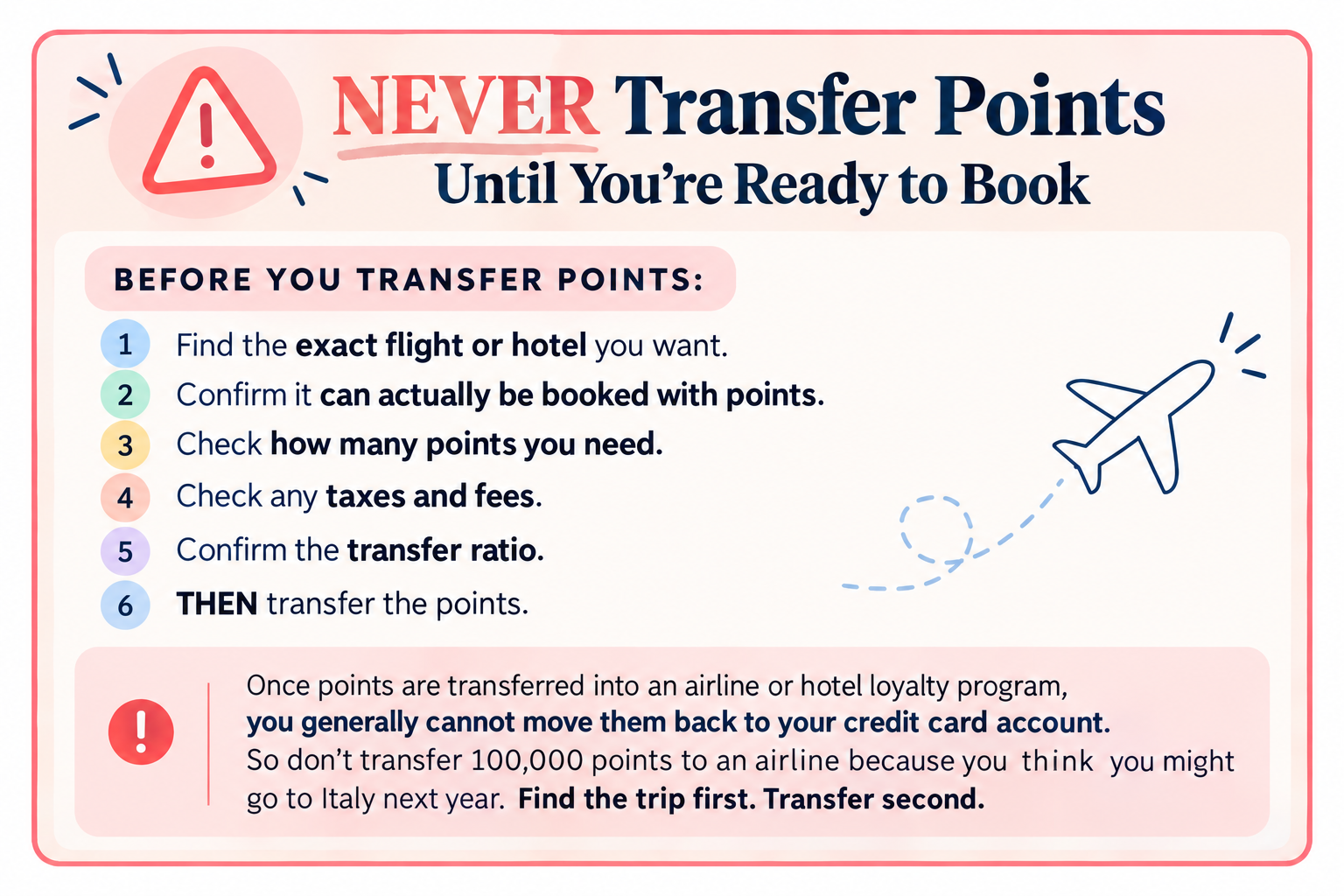
4. NEVER transfer points until you’re ready to book
Before moving points to an airline or hotel:
Find the flight or hotel → Confirm it’s available with points → Check the taxes + fees → THEN transfer
Transfers are generally final, so we never move points somewhere just because we might use them later.
When points clicked for me
I think the biggest misconception is that you need an enormous amount of points before they become useful. You really don't. The first time I used my points to travel, I booked a hotel for one night in NYC for 30K points.
Even if your points only cover:
- One person's flight
- Two hotel nights
- A rental car
or part of a bigger trip...
that's money that stays in your pocket. And with a family of four or five, knocking even 500–1,000 off the cost of a trip can make a HUGE difference.
EXAMPLES OF WAYS I’VE USED MY POINTS:
Example 1: Hotel in NYC WITH POINTS
We transferred from Chase → Hyatt
Then booked: Thompson Central Park
Cash price: $659/night
Points price: 30K points/night (2.17 cents per point)
What we paid: 60K for 2 nights
EXAMPLE 2: Flight from D.C. TO LONDON
We transferred from Chase → Virgin Atlantic.
Then booked: Direct flights from Washington Dulles to London Heathrow
Cash price: $799
Points required: 6,000/Points per person (10.62 cents per point!)
Taxes/fees: $162
How Do You Know if Using Points Is a Good Deal?
This is where people can make points WAY more complicated than necessary. There are formulas for calculating “cents per point.” There are spreadsheets. There are entire websites dedicated to maximizing every single point. And if you love that stuff…go for it. 😂
But this is how we usually start:
Look at the CASH price.
Then look at the POINTS price. Ask yourself: Would I rather spend the cash or use these points? For example:
HOTEL A
Cash price: $175/night
Points price: 30,000 points
Maybe I’d rather save my points.
HOTEL B
Cash price: $650/night
Points price: 30,000 points
NOW I’m paying attention. 😂 That doesn’t mean Hotel B is automatically the better redemption — but it gives you a really easy place to start comparing.
Our Rule: Always Search BOTH Ways
Before booking something with points, we usually compare:
1. The cash price - How much would we pay if we booked normally?
2. The credit card travel portal - How many points would it require there?
3. The airline or hotel loyalty program - Could we transfer points and book it for less?
There isn’t one method that is ALWAYS best.
That’s why we compare.
‼️ Don’t Forget About Taxes + Fees
This matters especially with flights. A flight might only require a relatively small number of points but still have significant taxes, carrier fees or surcharges. So don’t look only at: “It costs 30,000 points!” Look at: 30,000 points + HOW MUCH cash? Sometimes paying a little in taxes and fees is totally worth it. Other times, those fees make the redemption much less appealing.
Award Availability: The Part Nobody Explains at First
Here’s another term you will hear:
Award availability
This simply means: Can you actually book that flight or hotel using points? A flight having empty seats does NOT necessarily mean those seats are available to book with miles. Likewise, a hotel can have rooms available for cash but no rooms available using points. This is why you always want to search for the award first, then transfer your points.
Do Points Expire?
It depends. Flexible credit card points, airline miles and hotel points all have different rules. Some points may remain active as long as your account stays open and in good standing. Others may expire after a certain amount of inactivity. That’s another reason I prefer keeping flexible points inside the credit card program until I know where I want to use them.
Always check the specific program’s current rules.
What Is a Sign-Up Bonus?
You’ve probably seen offers like: “Earn XX,000 bonus points after spending $X in the first X months.”
This is commonly called a:
Welcome bonus
Sign-up bonus
New cardmember offer
These bonuses can be one of the fastest ways to build up a meaningful points balance. But there is one rule I would NEVER break:
Do not spend money you wouldn’t normally spend just to earn the bonus.
If you know you naturally have enough normal expenses coming up to meet the spending requirement, great. If you’re buying random things you don’t need just to hit the bonus? That defeats the whole purpose.
What Is a Transfer Bonus?
Every once in a while, credit card rewards programs offer bonuses when transferring points to certain airline or hotel partners.
For example — purely as an illustration. Instead of: 1,000 points → 1,000 miles
You might temporarily receive: 1,000 points → 1,200 miles
That can make a good redemption even better. BUT…
Do not transfer points just because there is a bonus.
A 20% transfer bonus doesn’t save you anything if those points end up sitting unused in an airline account for three years. Find the trip first. Then see whether a transfer bonus helps.

What Credit Card Should a Beginner Get?
This is the question everyone wants answered. And unfortunately: There is no one “best” travel card for everyone. Before choosing one, look at:
➡️ Annual fee: Are the benefits worth paying the annual fee every year?
➡️ Welcome offer: How many points could you earn, and what spending is required?
➡️ Earning categories: Do you spend most of your money on:
Dining?
Groceries?
Travel?
Gas?
Everyday purchases?
Pick a card that rewards the way YOU already spend.
➡️ Transfer partners: If you already know you love a particular airline or hotel brand, check whether the card’s points transfer there.
➡️ Travel benefits: Depending on the card, these might include things like:
Travel credits
Airport lounge access
Rental car coverage
Trip delay protection
Baggage coverage
Global Entry or TSA PreCheck credits
No foreign transaction fees
Benefits vary significantly by card, so always read the current terms before applying.
Already have a bunch of points and not sure how to use them?
My biggest advice is: Don’t just book directly in the credit card portal!
You almost ALWAYS will get the most value per point by transferring the points out of the card and to the hotel or airline directly.
I would look at what Transfer Partners your card has. For instance, if all your points are with Chase and you want to use them to buy flights, you can transfer those points to airlines such as Jetblue, United, Virgin Atlantic, etc.
I would also check which transfer bonuses your card currently has, which is how you can make some AMAZING redemptions happen!
8 Beginner Mistakes to Avoid
1. Carrying a balance just to earn points - Interest can wipe out the value of your rewards.
2. Transferring before finding award availability - Always search first.
3. Assuming the travel portal is always the best deal - Compare your transfer partners too.
4. Assuming transferring is always the best deal - Sometimes the portal or cash price is better.
5. Ignoring taxes and fees - Especially on international flights.
6. Opening a card you can’t justify long-term - Consider the annual fee and benefits.
7. Using points just because you have them - Save them when the cash price is low.
8. Making points WAY too complicated - This one might be the biggest. 😂
You do not need to maximize every point perfectly. If your points helped you take a trip for less money? That’s a win.
The Biggest Thing I Want Beginners to Know You do NOT have to become a professional “travel hacker.” Start with one card. Learn one points program. Pick one trip. And see if those points can help cover one part of it. Maybe that's two nights in a hotel. Maybe it's one person's flight. Maybe it's $500 you don't have to take out of your travel budget.
Once you successfully use points for the first time, the whole process starts to make SO much more sense. And that’s when you realize: Ohhhhh. THIS is why people get so excited about points. ✈️
FAQ: Traveling With Credit Card Points
Q: Can you really travel for free using points?
A: Sometimes points can cover the entire cost of a hotel stay or the base airfare for a flight, but I’m careful about calling travel “free.” You may still pay things like: Taxes, Fees, Resort fees, Transportation, Food & Credit card annual fees. I prefer saying that points can help make travel significantly cheaper.
Q: Do you need good credit to use travel rewards cards?
A: Most premium travel rewards cards are designed for applicants with stronger credit profiles, but approval requirements vary by issuer and product. Check the card issuer’s current terms and consider your overall financial situation before applying.
Q: Do you need multiple credit cards to travel with points?
A: No. You can absolutely start with one card and one rewards program. Honestly, I think that's much easier when you're learning.
Q: Is it better to use points for flights or hotels?
A: It depends on the trip. We use them for both. Instead of deciding in advance that points are “for flights,” compare where they save you the most money for the trip you're actually taking.
Q: Should I transfer points as soon as I earn them?
A: Usually, no. We generally keep flexible points in the credit card account until we are ready to book something. That keeps our options open.
Q: Can you combine points between different credit card programs?
A: Usually not directly. Each rewards ecosystem has its own rules. However, two programs may sometimes share the same airline or hotel transfer partner, which can create additional booking options. Always check the rules before transferring.
Q: How long do point transfers take?
A: It varies. Some transfers happen almost instantly, while others can take hours or even days. Always check the expected transfer time before moving points, especially if award availability is limited.
Want to Start Earning Travel Points?
These are the travel cards we use + recommend :
**Jolly Good Travel may recieve compensation from JPMC and is a cardratings affiliate. Credit card rewards, benefits, transfer partners, transfer ratios and welcome offers can change. Always confirm the current terms directly with the card issuer or loyalty program before applying for a card or transferring points. We only recommend using credit cards if you can pay your balance responsibly and avoid carrying high-interest debt.